


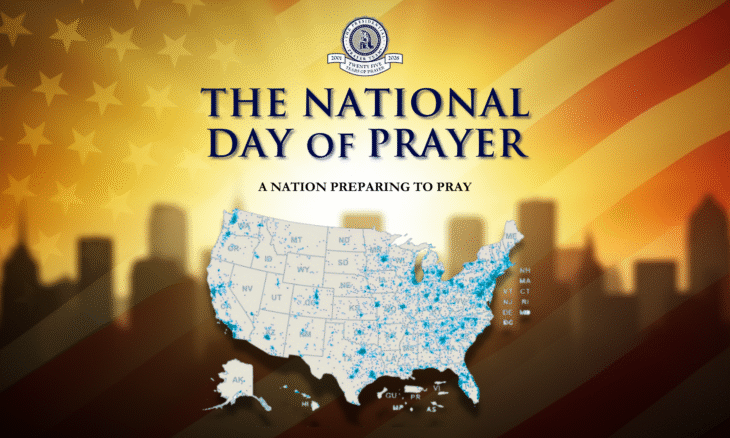
Why leaders have repeatedly turned to prayer during national challenges and transitions.
PRAY FIRST for God to give a spirit of humility and wisdom among national leaders as they guide the country through complex times. Looking for National Day of Prayer resources? Get started HERE.
But the wisdom from above is first pure, then peaceable, gentle, open to reason, full of mercy and good fruits, impartial and sincere. James 3:17
In moments of national crisis, American presidents have often turned to something greater than themselves. Not just for personal comfort, but to invite the nation into a collective reflection. From the Revolutionary War to the present day, these calls to prayer have served as more than ceremonial gestures; they have been attempts to unify a diverse people around shared values, humility, and hope.
In his 1789 Thanksgiving Proclamation, George Washington urged Americans to offer gratitude and seek divine guidance for the emerging democracy. His call was not merely religious but civic and stressed the need for not only national character but also moral fortitude. Decades later, Abraham Lincoln, amid the Civil War, proclaimed a national day of “humiliation, fasting, and prayer,” urging citizens to seek forgiveness and healing. His words reflected a deep awareness of the moral weight of leadership and the nation’s collective conscience.
Perhaps one of the most touching examples came on June 6, 1944, when President Franklin D. Roosevelt addressed the nation via radio as Allied troops stormed the beaches of Normandy. Rather than a traditional speech, Roosevelt led the country in a six-minute prayer, asking for strength, faith, and endurance. It was a moment of profound vulnerability and unity, as millions of Americans joined in silent support.
Subsequent presidents continued this pattern, particularly during times of global tension and national trauma. Harry Truman affirmed prayer as vital to national strength when he signed the law establishing the National Day of Prayer in 1952. During the Cold War and after the attacks of September 11, prayer was again invoked as a means of courage, comfort, and resolve in the face of fear and uncertainty.
A National Tradition of Reflection and Renewal
The National Day of Prayer, observed annually on the first Thursday of May, stands as a continued expression of this national tradition. It invites Americans, people of faith and those who simply value reflection, to consider the moral and spiritual dimensions of civic life. For many faith communities, these observances move beyond words, inspiring acts of service such as caring for the vulnerable, comforting the grieving, and pursuing justice. Time and again, moments of reflection paired with tangible compassion have helped Americans respond to loss and uncertainty.
Looking back on presidential calls to prayer prompts enduring questions: What kind of nation do we aspire to be? How might humility, compassion, and shared responsibility shape our life together? These are not partisan questions, but human ones that are rooted in conscience, character, and care for one another.
Whatever our politics, such moments offer an opportunity to pause, to examine ourselves honestly, and to seek renewal. Whether expressed through prayer, service, or shared remembrance, they invite us to recommit ourselves to one another and to the values that will guide our nation in the generations ahead.
America 250: A Moment to Remember—and to Return
Unless the LORD builds the house, those who build it labor in vain. Unless the LORD watches over the city, the watchman stays awake in vain. Psalm 127:1
As we approach America’s 250th anniversary, it is worth noting that historians sometimes point to a sobering pattern: many great powers have risen, peaked, and begun to unravel within roughly ten generations, a window America is now entering. The number is not a prophecy, but the warning is real. Nations can drift from their moral center long before they lose their strength.
And yet, the truest story of America is not found in the rise and fall of empires, but in the enduring faithfulness of God. Through war and division, revival and drifting, tragedy and prosperity, the Lord has sustained us far longer than any human wisdom could guarantee. So the question before us is not whether we can preserve an “empire,” but whether we will remember the Lord, so that the next 250 years are marked not merely by achievement, but by humility, repentance, justice, and peace.
Considering this milestone, President Trump has called on the nation to pray. In addition to the National Day of Prayer on May 7, he also called for an additional day of prayer ten days later, on May 17, inviting Americans to lift up the nation and renew a public commitment to be “One Nation Under God.”
Why It Matters and How We Can Respond
The National Day of Prayer is not ultimately about a proclamation, a ceremony, or a moment on a calendar. It is a reminder that, sooner or later, every nation reaches the edge of what politics, wealth, and willpower can accomplish, and we must seek God for what we cannot produce on our own: wisdom, repentance, courage, grace, and peace. Across American history, leaders have turned to prayer when the stakes were high because it names a deeper truth: a nation cannot heal without humility, and public life cannot be sustained without moral clarity.
For followers of Jesus, this day is an invitation to respond in a distinctly Christian way: to intercede without performing, to speak with conviction without contempt, and to pursue reconciliation without surrendering truth. It is a reminder that the most powerful thing we can do for our country is often done on our knees. Prayer transforms us; it softens what is hard in us and opens our hearts and minds to His will. It also propels us outward, toward neighbors, community, and even those we disagree with, so that our public witness is measured not only by what we say, but by the grace we show and the peace we pursue.
In the end, our history is a testament that while leaders sign the proclamations, it is the heart of a people seeking the Lord that invites His hand to heal and sustain the land.
HOW THEN SHOULD WE PRAY:
— PRAY FOR UNITY: Intercede for all our communities across the nation, asking that we would seek understanding and a shared sense of purpose over division. May the God of endurance and encouragement grant you to live in such harmony with one another… that together you may with one voice glorify the God and Father of our Lord Jesus Christ. Romans 15:5–6
— PRAY FOR GRACE: Ask that all who are in authority would model grace and truth in public discourse, especially when engaging with opposing views. Let your speech always be gracious, seasoned with salt, so that you may know how you ought to answer each person. Colossians 4:6
— PRAY FOR REDEDICATION: Lift up the gatherings on May 7 (National Day of Prayer) and May 17 (The National Jubilee of Prayer), asking that these moments would move beyond ceremony to a true heart-level rededication of our nation to God. Blessed is the nation whose God is the Lord, the people whom he has chosen as his heritage! Psalm 33:12
CONSIDER THESE ITEMS FOR PRAYER:
- Pray godly discernment and moral fortitude for the President, Congress, and all officials, that they may lead with both conviction and a spirit of humility.
- Pray that our leaders would lead the way in returning to our nation’s moral center, seeking the wisdom to address past failings with honesty and the grace to build a more just future.
- Pray for the next generation to grow in wisdom, courage, and a heart for reconciliation.
Prayer Changes Nations and Hearts
Will You Join Us?
Prepare your heart and plan for the day
– Tell us when you plan to pray: ▶ Sign up for the National Prayer Room
– Invite one or more friends to join with you.
▶ Call and record your prayer: 1-844-829-2022 (toll-free)
Online prayer activities coming May 7th
– Read, pray, and post your own prayers in the National Prayer Room
– Listen and pray along to continuous prayer stream from other members
“Rejoice in hope,
be patient in tribulation,
be constant in prayer.”
Romans 12:12
FREE DAILY PRAYER BRIEFINGS
A short morning email with focused prayer points for our nation and its leaders. Trusted by thousands each day, join us in faithful intercession.
Just enter your email. Free to join. Cancel anytime.
Sources: National Archives, Abraham Lincoln Online, The American Presidency Project, University of California Santa Barbara, Pew Research Center, White House, Congress.gov, USA Today, Gov Info, The Constitution Online
RECENT PRAYER UPDATES